TRAVELLING HOPEFULLY
A blog about going places and the English we find there
Travelling Hopefully · Post 07
Everything We Heard in Rome (Mostly)
by Bud (Bogdan Constantin)
Rome is very big. Stan knows this because he made a map of it. The map has eleven colours. (I asked what the eleventh colour was for. He said, ‘Contingencies.’ I stopped asking.)
Then we found the red bus. It is called a hop-on hop-off bus. You get on, you get off, you get on again. It has no roof. Every seat has headphones, and a voice tells you everything about Rome while you sit in the sun. I loved it at once.
Each seat has a little dial, with a language for every number. Stan and I looked at the dial. Then we both said ‘English’ at exactly the same time. (Stan says he said it first. He did not. I was louder.) We write a blog in English. It would be strange to listen to Rome in any other language. It is basically our job. Wei-Li turned her dial to Mandarin without a word. ‘Easier,’ she said. I understood. She listens to our English all day, so she deserves a holiday from it.
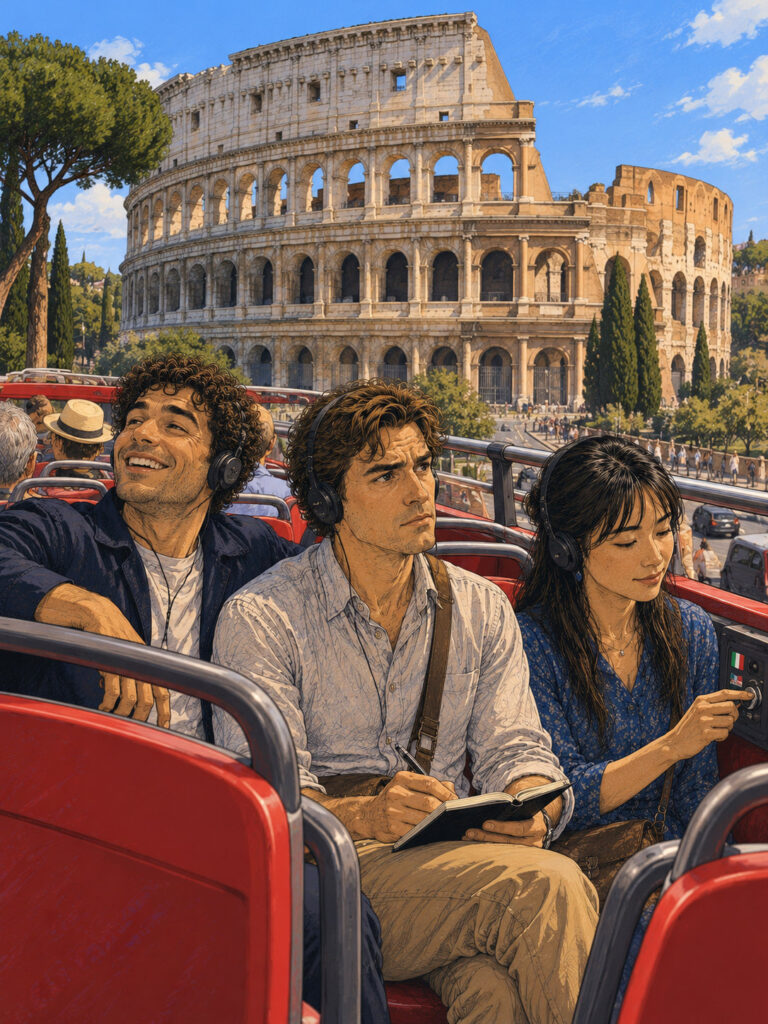
The voice in my headphones was a very calm man with a very fast English.
We got off the bus at the Colosseum and just stood there. It is nearly two thousand years old. Emperor Vespasian started it, and his son Titus opened it. Gladiators fought here, and wild animals too. Fifteen thousand people assisted the games here. Fifteen thousand! That is what the voice said. I tried to imagine the noise. I took forty-one photographs. Stan looked at me with his Rough Guide face. Then he wrote something in his notebook, and said nothing. I thought: good. He is learning.
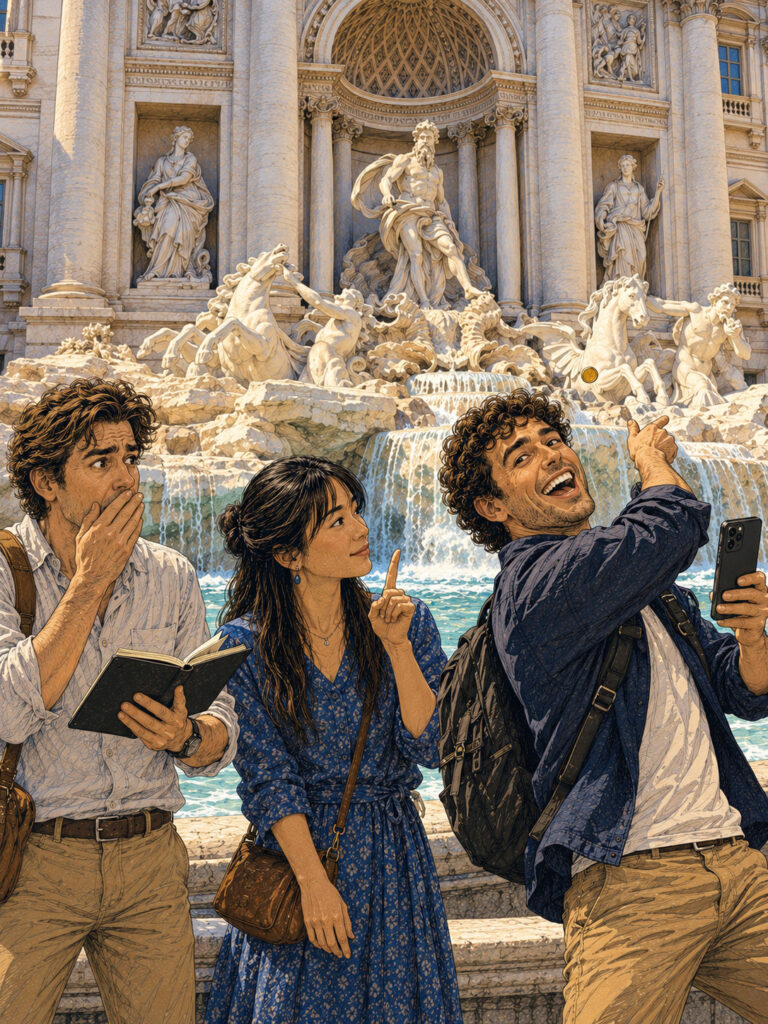
We hopped off again and walked to the Trevi Fountain. (The bus cannot go there. The streets are too small. Stan says this is a fact. I say the bus is too proud.) The ticket also had an app, so the voice came with us in our headphones. The fountain is huge. It is white stone, with a god in the middle and stone horses, and water everywhere, and more people than I have ever seen in one small place.
The voice said that if you throw a coin, you will come back to Rome. The voice said more after that. It said something about two coins, and then three coins, but it was very fast and I only heard ‘three’. Three is more than one. (This is just maths.) So I have throwed three coins into the water. I used my right hand, over my left shoulder, like the voice said. The voice said that every day workers collect the coins and give the money to charity. So nothing was wasted. Stan made a small noise. He said, ‘Bud. Three coins is a very specific choice.’ I asked what he meant. He said he would explain when we were not in public. Wei held up one finger. I held up three. Nobody won.
The voice said that if you throw a coin, you will come back to Rome. The voice said more after that. It said something about two coins, and then three coins, but it was very fast and I only heard ‘three’.
Then we went to the Spanish Steps. There are 135 of them, said the voice. (Stan counted them on the way up. He did not tell us his number. He did not look happy.) They are called the Spanish Steps because the Spanish built them for the French church at the top. I think this is lovely. One country gave a gift to another country. At the top you can see across the whole city. Wei took off one headphone and said, ‘Interesting.’ She said it in the voice she uses when she is not saying something else.
It was a perfect day. We saw three huge things, we heard everything, and I understood all of it. (Wei did not say anything. She smiled at her phone. Stan read his notebook with a face I do not like.) Tomorrow is the Vatican. Stan says people must cover their shoulders there. My jacket has very good shoulders for this. (Marco’s uncle planned it. I am sure.)
Not all those who wander are on the right channel. But we are in the right city.
Bud
A note on my own previous post, and on today.
First: Wei corrected four prepositions in Post 06. I wish to report that today I got on the bus three times and off it three times. I used no wrong preposition. This required my full attention. I do not recommend it as a way to enjoy a bus.
Second: Bud writes that we both said ‘English’ at exactly the same time. We did not. I said it first, and more calmly. The audio guide was my proposal. It has been in Tab 2 since March.
Third: the Rough Guide (2009) says the Colosseum held ‘around fifty thousand’ people. Bud wrote fifteen. I did not correct him at the time, because he was happy. I have recorded this in Tab 10 (Cultural Observations) as an unusual event.
Fourth: Bud writes that I said ‘three coins is a very specific choice’ and that I would explain later. I have not explained. I would like Wei to do it. I have added the incident to Tab 4, sub-category: Arguments — Unresolvable (Pending).
I am writing this in a café near our hotel. Stan is checking the Vatican tickets for the fourth time. Bud is asleep, still wearing his headphones. They are on the English channel. I listened to the tour in Mandarin, so I can tell you exactly what the audio said. I have reviewed Bud’s post.
There are several errors, and some of them are not grammar errors at all.
1. Assist or attend? Bud writes ‘fifteen thousand people assisted the games.’ In English, assist means help: ‘A guide assisted us at the ticket office.’ To go to an event, we use attend: ‘Fifty thousand people attended the games.’ In Romanian, a asista can mean to be present at an event, so the mistake is natural. In English, it changes the meaning completely. Bud’s sentence says the crowd helped to run the games.
2. Fifteen or fifty? The audio said fifty thousand. Bud heard fifteen. In English the stress is different: fifTEEN (the end is strong) and FIFty (the start is strong). A fast voice makes this hard to hear. In Mandarin, the two numbers sound very different, so I had no problem. Fifteen thousand would be a quiet afternoon.
3. Past tense. Bud writes ‘I have throwed three coins.’ There are two problems. First, ‘throwed’ is not a word. The verb throw is irregular: throw, threw, thrown. Second, Bud is telling what happened in his story, so he needs the past simple, not the present perfect: ‘I threw three coins.’ This is the same family as ‘have spend’ in Post 01 and ‘have ate’ in Post 04. We are keeping a list.
4. The coins. The audio explained the popular tradition. Stand with your back to the fountain and throw one coin with your right hand over your left shoulder. One coin means you will return to Rome. Two coins mean a new romance. Three coins mean a wedding. Bud heard the word ‘three’ and decided that more was better. Stan understood the whole sentence. He has not yet told Bud what it means. I have decided that the readers have a right to know. The audio also said that the coins are collected every day and the money goes to charity. Bud understood that part correctly.
5. The Spanish Steps. The audio said the steps are named after the Spanish Embassy (the office of Spain in Rome), which is in the square at the bottom. French money paid for the steps, and they lead up to a French church. Bud wrote that the Spanish built them for the French. ‘Named after’ tells us where a name comes from. It does not tell us who built something. Compare: ‘The steps are named after the Spanish Embassy, but French money paid for them.’
Stan’s note reports a perfect day for prepositions. I can confirm it. I was listening carefully, and I am as surprised as he is.
Bud also writes ‘photographs’ correctly. I have written down the date.
Five errors corrected. Fourteen remain. The audio guide was accurate in both languages.
Which sentence is correct?
Which sentence uses assist correctly?
New posts coming soon!