TRAVELLING HOPEFULLY
A blog about going places and the English we find there
Travelling Hopefully · Post 02
We Are in Sicily (This Was Not the Plan)
by Stan (Stanislav Moraru)
I am writing this from the top bunk of a hostel in Palermo. The bunk below me belongs to a man named Joost, from Rotterdam, who has gone to sleep using my jacket as a pillow. I do not know when this happened. I have decided not to address it tonight. This is called adaptability, which is an important skill in travel. I like this word. Travelling with Bud requires it constantly.
We were supposed to be in Naples.
I want to be clear about this. The plan was Naples. I had researched Naples. I had Tab 4 of my spreadsheet — Contingencies (Weather, Transport, Medical, Other) — prepared specifically for the journey from the ferry port in Pozzallo to the bus station, and from the bus station to the city centre, and from the city centre to our accommodation, which had a rating of 7.4 on Booking.com and was described as having ‘a friendly atmosphere and reliable Wi-Fi, although the shower takes two or three minutes to warm up.’ I had noted the shower information in Tab 4. I was prepared.
The ferry arrived at Pozzallo at six forty-five in the morning. This was correct. This was according to schedule. I noted it in Tab 2 (Transport) with a small tick. I permit myself small ticks when things go according to schedule. Bud was asleep on his bag. Wei was standing at the rail looking at the harbour with an expression I have learned to recognise. It is the expression she has when she knows something is about to go wrong and has decided not to say anything because, in her own words, ‘it is faster to let you discover it.’
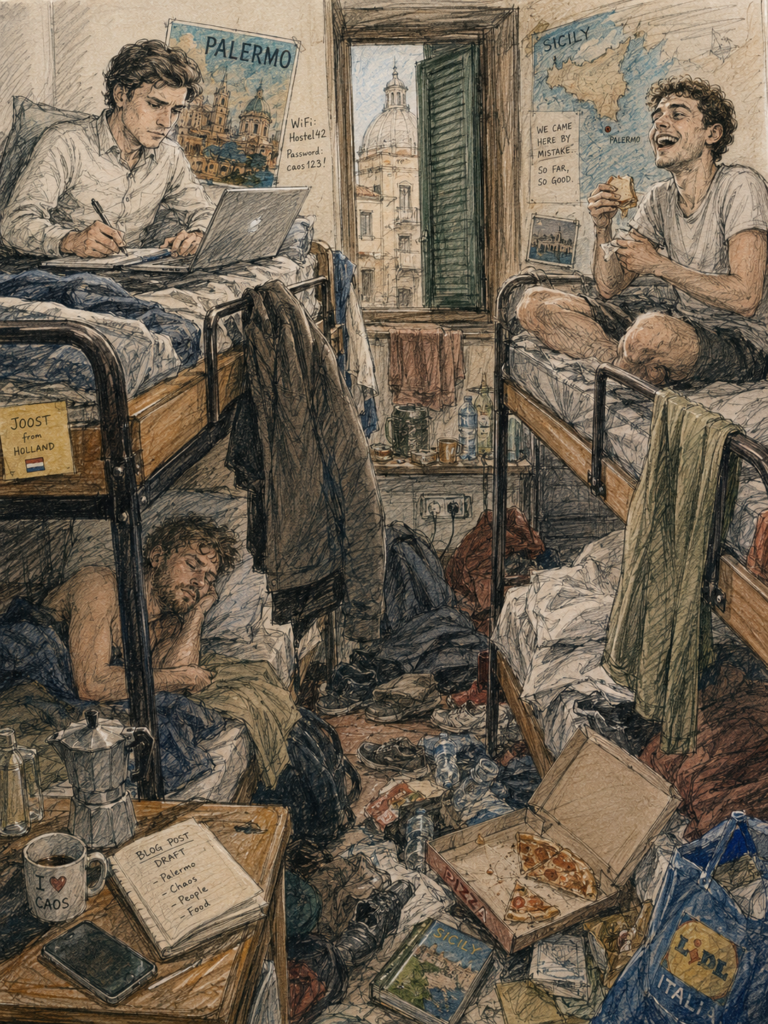
“This is called adaptability, which is an important skill in travel. I like this word. Travelling with Bud requires it constantly.”
The bus to Naples left from Pozzallo at seven-fifteen. I knew this because it was in my research. What I had not fully investigated — and I want to be precise here, because precision is important — was that there are two bus companies operating from Pozzallo in the early morning. One goes north, to Catania and eventually to Naples, which takes approximately nine hours and requires a change at Catania. The other goes west, directly to Palermo, in three and a half hours, with no changes, which is faster and therefore the one that Bud found us standing at when he woke up on the bus fifteen minutes after departure.
I should say: I did not choose this bus. I would like that to be clear. What happened was that Bud, operating on four hours of sleep and what he described as ‘a good feeling,’ picked up both our bags, said ‘this one,’ and walked towards the bus on the left. I was consulting Tab 4 at this moment. By the time I looked up, he was already on board. Wei had followed him, which I found surprising. When I asked her why, she said: ‘He had the bags. Also, I was curious to see what would happen.’
What happened was Palermo.
I will say this about Palermo: it is not what I researched. My 2009 Rough Guide gives it four pages and describes it as ‘a city of extraordinary energy, faded grandeur, and some of the best street food in Europe.’ This is accurate. What the guide does not describe — possibly because it is a 2009 guide and this was not yet a problem in 2009 — is the volume of tourists in May, the length of the queue for the Ballarò market at eight in the morning, or the fact that the hostel Bud found on his phone in eleven minutes was entirely full except for one room with four bunks and an emergency cot, which now has Joost’s bag on it. I have not determined who Joost is travelling with. He arrived after us and went to sleep very quickly.
Bud is pleased with this development. He has, since our arrival, eaten two arancini from a stall near the Quattro Canti, taken what I estimate to be sixty photographs, made friends with the owner of a bar on Via Roma, and learned to say ‘grazie’ with what he considers to be a very convincing accent. I asked him what our plan was. He said the plan was to ‘see what Palermo is like.’ I told him I have twenty-seven years of life experience and I know what a plan looks like, and this is not one. He said: ‘Stan, this is exactly a plan. It is just a flexible plan.’ Wei said nothing. She was editing something on her laptop with a look of deep concentration.
So. We are in Palermo. We will eventually get to Naples — or eventually we will change our minds and go somewhere else. By which I mean it is possible, though I am beginning to understand that ‘possible’ and ‘certain’ are different categories of thing when travelling with Bud. I have updated Tab 4. I have added a new sub-section called ‘Unplanned Destinations,’ which currently has one entry.
The hostel has Wi-Fi. It is faster than the one in Malta. I have noted this in Tab 7 (Connectivity). There are some positives.
Tomorrow I will research what there is to see in Palermo. The guide has four pages, as I mentioned. I will read them carefully. Bud has already, apparently, made a list of his own. It has three items: market, more arancini, and something he has written as ‘the big church??’ with two question marks. I have looked up the church. It is the Palermo Cathedral. It is Norman-Arab-Byzantine in style and is genuinely one of the most remarkable buildings in southern Europe. Bud will photograph it and call it ‘very old and incredible.’ This is not wrong. It is just not everything.
I am going to try to retrieve my jacket now. I will do this professionally.
Kind professional regards,
Stan (Stanislav Moraru, co-founder and logistics director)
A note from Stan
I need to correct something from Bud’s Post 01.
Bud said the plan for Italy was ‘flexibility.’ This is not what I said. I said that within a structured logistical framework, there is room for ‘contextual adjustment.’ These are different things. A flexible plan has no plan inside it. A contextual adjustment is a small, considered modification to a plan that exists. I had a plan. What we have in Palermo is a contextual adjustment. I have updated the spreadsheet accordingly.
Second: the bus. I have reviewed the timetable information available from my sources and I want to state clearly that the Pozzallo to Naples service is real and operates on the schedule I described. The issue was one of platform identification in low-light conditions with inadequate signage and a co-traveller who was already moving. This is a transport infrastructure problem. I have noted it in my feedback tab.
Third: I have twenty-seven years. I do not ‘have twenty-seven years of life experience’ in the way I wrote it in the post. Wei has corrected this in her note below. She is correct. The right sentence is ‘I am twenty-seven.’ In Romanian we say ‘am douăzeci și șapte de ani’ — I have twenty-seven years. This is a translation error. I am noting it here myself because I prefer to identify my own errors before Wei does. I do not always succeed in this.
Kind professional regards, Stan
Wei’s Editor’s Note
We are in Palermo. I knew at the bus station that something was wrong. I said: ‘Stan, which bus?’ Stan was looking at his spreadsheet. Bud was already moving. I made a decision. I am still deciding whether it was the correct one.
There are several errors in this post. The most important ones for the activities below:
1. “I have twenty-seven years.” In English, we use the verb be for age, not have. The correct sentence is: I am twenty-seven. Or: I am twenty-seven years old. Romanian uses ‘a avea’ (to have) for age — Stan has translated directly. This is a very common error for speakers of Romanian, French, Spanish, Italian, and other Romance languages. If you make this error too, you are in good company. You are also wrong.
2. “We will eventually get to Naples — by which I mean it is possible.” Stan is using ‘eventually’ to mean ‘possibly’ or ‘perhaps.’ In Romanian, ‘eventual’ means something like ‘possible’ or ‘maybe.’ In English, ‘eventually’ means ‘at some point in the future, after a long time or after some difficulty.’ Stan’s sentence is grammatically correct. It just means something different from what he intends. It suggests the journey to Naples will be long and difficult. Having met the bus situation, I think this may turn out to be accurate.
— Ed.
What does ‘eventually’ actually mean in English?
Which sentence uses ‘eventually’ correctly?
New posts coming soon!