TRAVELLING HOPEFULLY
A blog about going places and the English we find there
Travelling Hopefully · Post 04
We Are in Naples (This Was the Plan)
by Stan (Stanislav Moraru)
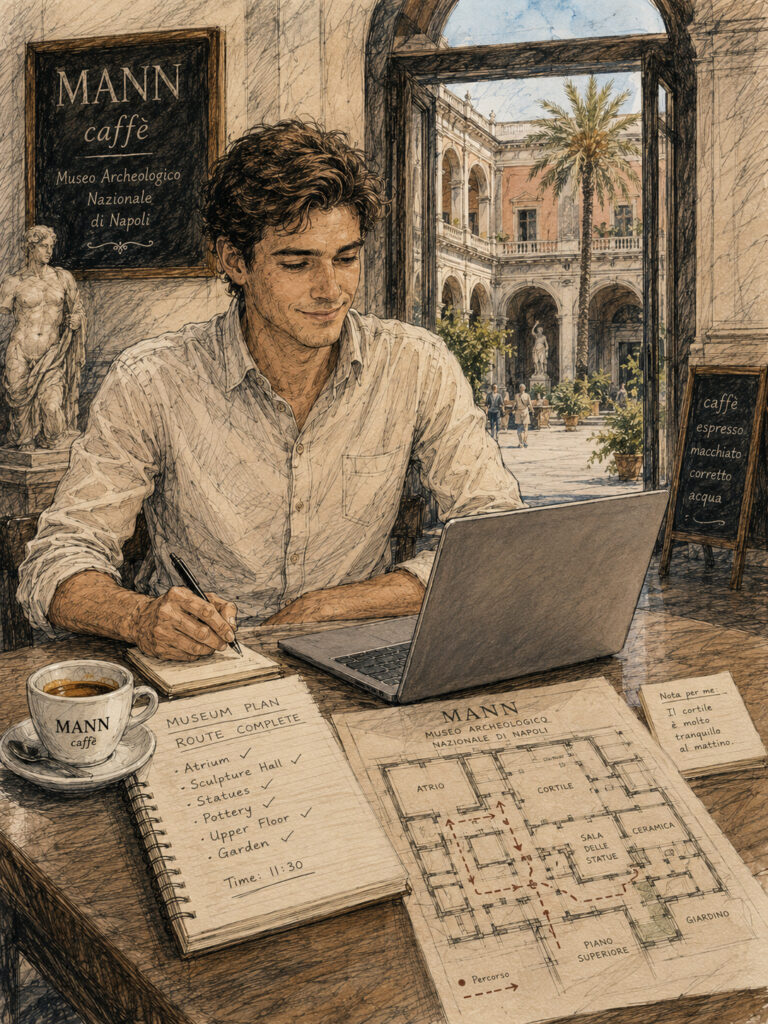
I am writing this from the café of the Museo Archeologico Nazionale di Napoli. I have taken an espresso — which is the correct for Naples, as I am reading — and I have my notes, and I have Wi-Fi, which I have assessed as acceptable (download speed: 14.3 Mbps; upload: 6.1 Mbps; I have noted this in Tab 7).
I am in Naples.
I want to say this clearly because for most of this trip, Naples was theoretical. It was the destination on Tab 1, the city in the research, the place where the bus from Pozzallo was supposed to take us before Bud decided to get on the other bus. Now I am here. I have a small tick in Tab 3. I am allowing myself to notice this.
Bud is not here. He left the museum at eleven twenty-three. He said he wanted to ‘feel the city.’ I have a note on this in Tab 4 (Contingencies — Personnel). He has since sent seven messages to the group chat. I will come to those.
First, the museum. I want to describe it properly because I have made a very careful research about it before our arrival, and I think this preparation was worthwhile.
The Museo Archeologico Nazionale is one of the great archaeological collections in Europe. I knew this from four sources. What I did not know — could not have known from sources — is what it feels like to stand in front of the Farnese Hercules, which is a marble statue approximately three metres tall of Hercules resting after his labours. He is enormous. He is tired. He is leaning on his club with the expression of a man who has completed something very difficult and is not yet ready to discuss it. I stood in front of him for six minutes. I had allocated four minutes. This was the only deviation from my schedule. I wonder if he had a Bud in his life as well.
The mosaics from Pompeii are on the upper floor. I had read about them. Reading about them is not the same as seeing them. The one called the Alexander Mosaic — which shows Alexander the Great at the Battle of Issus — is approximately five and a half metres wide and made from approximately one and a half million tesserae, which are small pieces of stone and glass. I have noted this in Tab 10 (Cultural Observations). A member of the museum staff — a very sympathetic woman who spoke some English — explained that they have been working on its conservation for many years. I thanked her. I meant it.
After this I came to the café. I organised my notes. I ordered my coffee. I began this post.
[Hercules] is enormous. He is tired. He is leaning on his club with the expression of a man who has completed something very difficult and is not yet ready to discuss it…I wonder if he had a Bud in his life as well.
Now. Bud.
The napolitane situation began on the bus from the airport. Bud had been looking at his phone. He said: ‘Stan. Naples. Napolitane. This is where they are from.’ I explained that this is not correct. The wafer biscuit known in Romanian as napolitane does not originate from Naples. It comes from the Viennese confectionery tradition — in Austrian German, Napolitaner refers to a layered wafer produced originally in Vienna, most famously by the Manner company, whose factory has been in Vienna since 1890. The name travelled across Europe separately from the product’s actual place of origin.
I had made a research on this specifically. I showed Bud the notes.
He said: ‘Stan, I hear you. But we are in Naples.’
This is not a logical response. I have noted it in Tab 4 under a new sub-category: Arguments — Unresolvable.
The group chat messages arrived as follows:
11:31 — ‘the first place didn’t know them. Showed a photo. The man was very nice. He suggested a different place.’
11:47 — ‘the second place also doesn’t know. But the woman showed me a sfogliatella which she says is THE pastry of Naples. I am not sure this is the same thing.’
12:04 — ‘I found a place near the port that has something similar maybe? A wafer thing. I am going in.’
12:19 — ‘that was something Austrian. Not the same. But okay.’
12:31 — ‘Stan, I found sfogliatelle. I think this is actually it. I am having one now. It is incredible.’
12:44 — ‘I am having another one. This is the best thing I have eaten since the arancini. I think Naples has won.’
12:58 — ‘I am bringing some for you and Wei. I got six. This is the mission completed.’
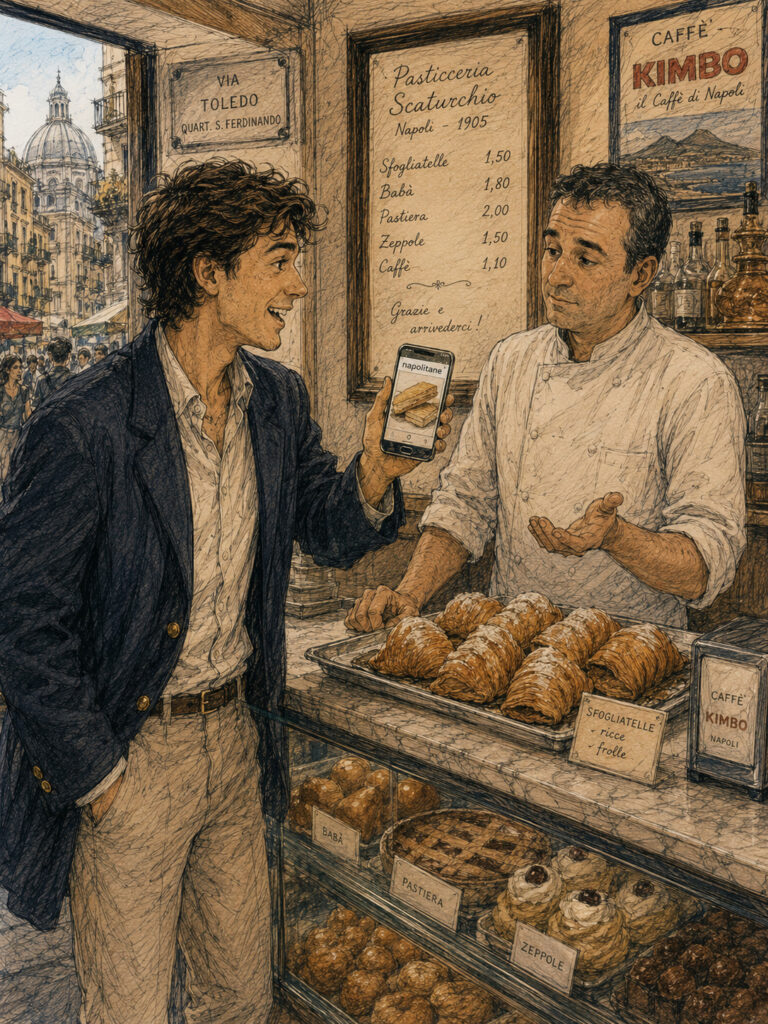
I want to note that the mission was not completed. The mission was to find napolitane in Naples. Sfogliatelle are a shell-shaped pastry filled with ricotta and semolina. They are not the same as a layered wafer biscuit. Bud has resolved this by deciding they are equivalent. I ate the sfogliatelle. I will not comment further on this.
Several corrections to Post 03.
First: the gate. Bud writes that I described our arrival as having ‘four minutes to spare.’ I did not say spare. Spare implies comfort — a margin you did not need. I said four minutes. The correct word is remaining. Four minutes remaining is a logistical observation. Four minutes to spare is a different attitude entirely, and not one I hold.
Second: the arancini. Bud writes that I ‘looked at it for a long time.’ This was eleven seconds. I was assessing the structural integrity of the bag. The arancini were good. I have noted them in Tab 8 (Food — Positive Experiences). This is only the second entry in that tab. I mention this because Bud suggested, in Palermo, that Tab 8 would never have any entries. It has two.
Third: the stative verb error. Bud writes ‘I am wanting to be clear’ in two places. Wei has addressed this below. I also identified it — in my own note, before Wei’s editorial. I want the timing recorded accurately. The timing is in the record.
I am in the apartment we have rented for three nights. Stan is at the museum. Bud is somewhere in the city with a photo of a biscuit and a great deal of confidence. I have reviewed Stan’s post.
There are several errors. The most important ones:
First: make research vs do research. Stan writes ‘I have made a very careful research about it’ and, later, ‘I had made a research on this specifically.’ In English, research is an uncountable noun. You do not make research. You do research. You can also conduct research, which Stan would prefer, as it sounds more professional. Both errors use the wrong verb. Both sentences need do, not make. This is a very common mistake. In this post, it is a very common mistake made twice.
Second: actual as a false friend. Stan writes ‘The actual situation in Naples…’ He means the current situation — what Naples is like today, now, at this moment. This is the Romanian false friend: actual in Romanian means contemporary or present-day. In English, actual means real or genuine — as opposed to something imagined or reported. ‘The actual building’ means the real building, not a photo of it. It says nothing about time. The correct sentence would be: ‘The current situation in Naples…’ or ‘Naples today…’
Third: take vs have for food and drink. Stan writes ‘I have taken an espresso.’ In English, we do not take a coffee, a meal, or a drink. We have them. The correct sentence is: ‘I have had an espresso.’ Or simply: ‘I have an espresso.’ We will return to take and have in a future post — this error is more common than it looks.
Fourth: irregular past participles and subject-verb agreement. Stan writes ‘the best thing I have ate in this country.’ The past participle of eat is eaten, not ate. We covered irregular past participles in Post 01. The correct sentence: ‘the best thing I have eaten.’ Stan also writes ‘the pavements is narrow.’ Pavements is plural — the correct verb is are, not is. Two errors in one paragraph. I have noted this.
Stan also describes a museum staff member as ‘very sympathetic.’ We covered sympathetic in Post 01. The word he wants is kind or friendly. I have no further notes on this.
Five errors corrected. We are in Naples. Progress continues.
Which sentence is correct?
Which of these uses make correctly?
New posts coming soon!