TRAVELLING HOPEFULLY
A blog about going places and the English we find there
Travelling Hopefully · Post 05
Sometimes It IS About the Destination
by Stan (Stanislav Moraru)
We had been waiting in the bus stop for perhaps ten minutes when it arrived, already half full, and Bud said something about how in Romania we would have called this crowded and in Italy this is apparently normal. We got in the bus at 9:14. I have this time because I looked at my phone specifically to have it.
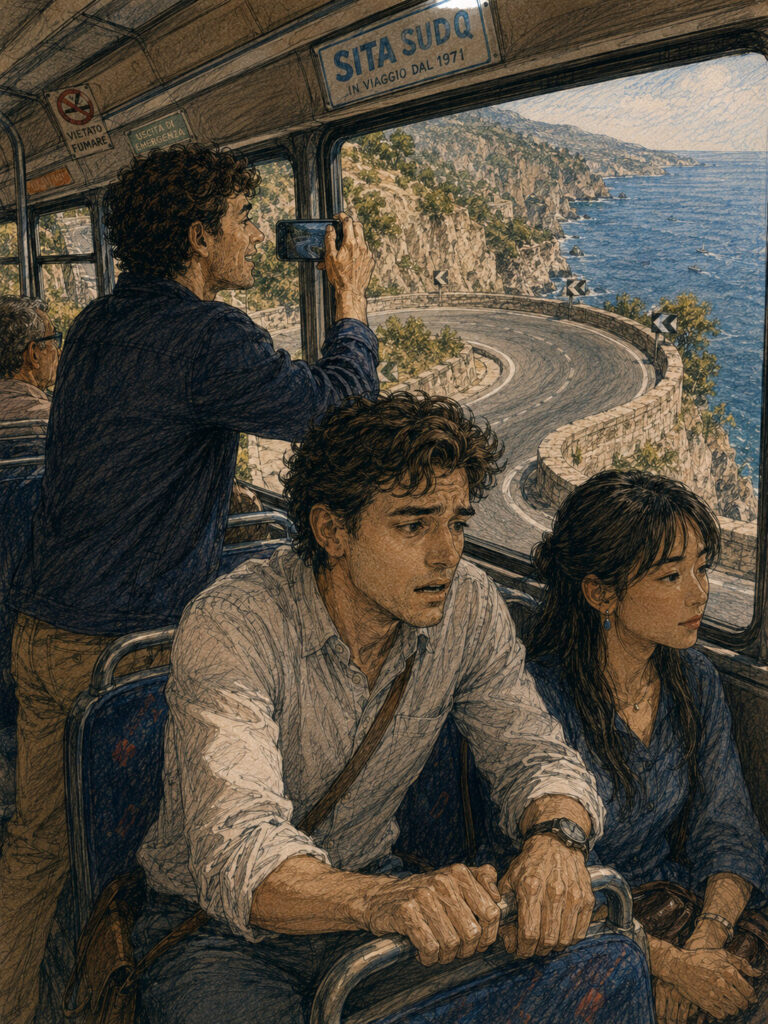
The road out of Amalfi does not so much climb as insist. It goes up, and then it goes sideways, and then it goes up again in a different direction, and the driver treats each of these transitions as an opportunity to demonstrate confidence. I do not enjoy this. I would like to state that plainly and move on.
‘Stan. It’s not for the destination. It’s for the journey.’
Bud filmed most of it. He stood — or half-stood, which is what standing becomes on a bus like this — with one hand on the rail and the other holding his phone toward the window, narrating for an audience I assume exists somewhere. I looked out from the window once, decided this had been a mistake, and did not look again for some time.
At one point, somewhere around the fourth or fifth turn that felt unnecessary, he turned to me and said: ‘Stan. It’s not for the destination. It’s for the journey.’ I wanted to point out that the correct version of this requires neither preposition — it is simply ‘It’s not the destination, it’s the journey’ — but I did not have the strength to do this at the time. I nodded instead. I want to be clear, for the record: the nod did not mean I agreed with him. I simply felt too ill to argue about it.
I would like to say, now that we have arrived and I am able to form complete sentences again, that I do not fully agree with him. I think the destination matters. I think it is allowed to matter. I am aware that I may be saying this partly because Bud said the opposite and I did not want to agree with him on a bus while feeling the way I was feeling. I am choosing not to examine this further.
Wei produced a small packet of ginger candy from her bag at some point during the second half of the journey, without being asked, and put it on the seat beside me without comment. I do not know if she anticipated this specifically or if she simply travels prepared for a wide range of outcomes. I ate the candy. It helped somewhat. I have not thanked her properly for this yet. I am doing it now: thank you, Wei.
We arrived to Positano a little after ten, and the bus emptied onto a road with no clear pedestrian provision, and everyone simply walked toward the view, because the view makes the argument for itself. The town goes down instead of along — houses stacked into the cliff in yellow and pink and a green I do not have a precise word for, all the way to a small beach and a sea that was doing the specific bright blue that photographs never quite capture. I understand now why people describe this coastline the way they do. I had assumed some exaggeration. There was no exaggeration.
not think today is the day.’
I said we should just go. I said Pompeii has been there for almost two thousand years and it was not going anywhere in the next six hours. Stan said this was ‘not the argument I think it is.’ Wei, who had said nothing for several minutes, closed her phone and said: ‘The 11:12 leaves in eighteen minutes. If we are going, we are going now.’ This settled it more than anything I said.
We ran. Stan carried his spreadsheet on his phone and read train times aloud as we went, which I found stressful and also, somehow, reassuring. I was wearing the navy jacket, which is still slightly too big at the shoulders, and I did not have time to notice this until we were already on the train.
I understand now why people describe this coastline the way they do. I had assumed some exaggeration. There was no exaggeration.

I have added a note to Tab 4 under a new sub-category: Motion Sickness (Personal, Not Transport-Related). I want to be clear that this is not a criticism of the bus. The bus did everything correctly. I did not.
We have a granita each — lemon, extremely good, new entry in Tab 8 — and I am writing this from a wall that appears to have been built specifically for people to sit on and recover.
Kind professional regards,
Stan (Stanislav Moraru, co-founder and logistics director)
Several corrections to Post 05.
First: Bud describes me looking at Tab 2 ‘the way people look at weather they do not trust.’ I want to state that this was an accurate assessment, not a dramatic one. The weather, in this metaphor, did not arrive on time and required a change of plan at short notice. I do not think distrust is the wrong word.
Second: Bud writes that I found walking without a plan ‘very difficult to accept for the first twenty minutes.’ This was closer to thirty-five minutes, if we are being accurate, which I believe is the standard we are holding each other to in this publication.
Third: Bud quotes me as saying we had seen ‘approximately forty per cent of the site, which exceeds my revised expectations.’ This quote is accurate. I want to add, for context, that my original expectation was fifteen per cent. I am capable of revising expectations upward when the situation warrants it. I would like this on the record.
I am writing this from the wall in Positano where Stan is recovering. Bud is filming the view, which he has now decided is also ‘for the journey.’ I have reviewed Stan’s post.
There are several errors, and this time they are mostly one family of error, which makes them easier to explain together.
1. Stan writes ‘we got in the bus.’ In English, larger vehicles you can stand up and walk around in — buses, trains, planes — take on and off. Smaller vehicles you sit straight down into — cars, taxis — take in and out of. The correct sentence: ‘we got on the bus.’
2. Stan writes ‘we had been waiting in the bus stop.’ A bus stop is a point, not a container — you wait at it, not in it. The correct sentence: ‘we had been waiting at the bus stop.’
3. Stan writes ‘I looked out from the window.’ The standard preposition here is of, not from: ‘I looked out of the window,’ or, informally, ‘I looked out the window.’
4. Stan writes ‘we arrived to Positano.’ This is the same error Bud made in Post 05, arriving to Pompeii. I want to note this clearly: this is not a personal failing of either Bud or Stan. It is a single interference pattern from Romanian, and it does not care which co-founder is writing the post. The correct sentence: ‘we arrived in Positano’ or ‘we arrived at Positano.’
Stan also writes ‘I did not have seat for the first twenty minutes.’ The correct sentence needs an article: ‘I did not have a seat.’ We covered article omission in Post 05, so I will leave it at that.
Four errors corrected. Twelve remain.
Which sentence is correct?
Which sentence is correct?
New posts coming soon!